

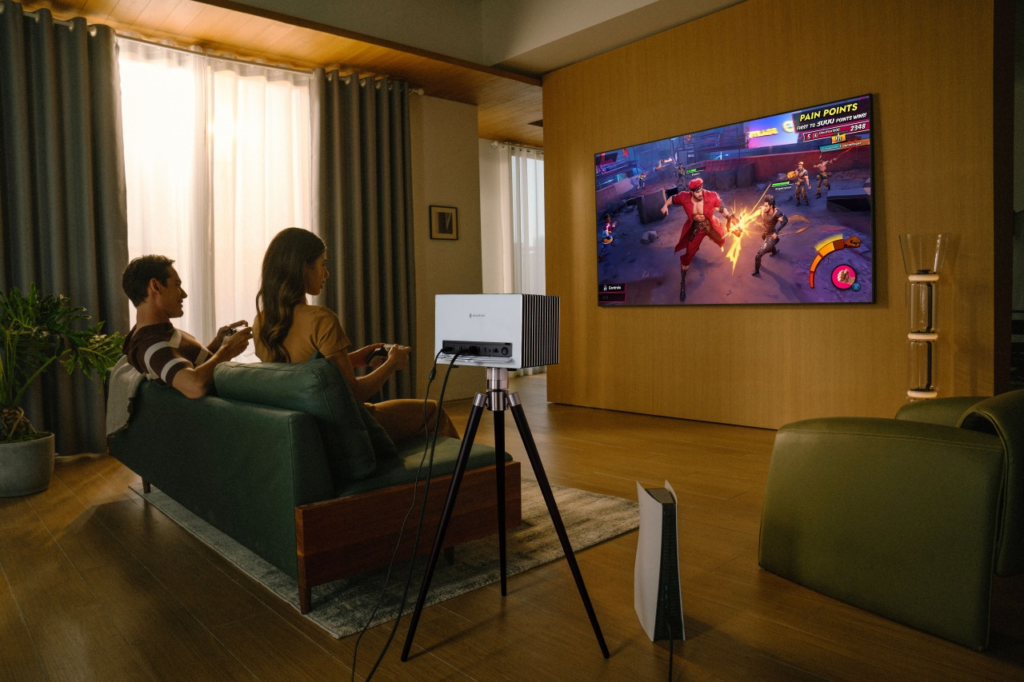
For years, the conversation surrounding home entertainment technology has been dominated by a single metric: resolution. We have moved from standard definition to high definition, and now to Ultra High Definition (UHD), or 4K. Marketing materials often focus entirely on the pixel count, boasting about the eight million pixels that 4K offers compared to the two million found in 1080p. While this arithmetic is accurate, it fails to capture the true value of the upgrade.
In the world of projection, 4K is not simply about making an image sharper; it is about altering the relationship between the viewer and the screen. It shifts the experience from merely watching a video to feeling truly present in a scene. This transition from resolution to immersion is driven by several optical and psychological factors that go far beyond a simple pixel count.
The Relationship Between Size and Pixel Density
To understand why 4K matters more for projectors than for televisions, one must look at pixel density. On a 50-inch television, the difference between 1080p and 4K is visible but often subtle from a normal viewing distance. The pixels are already so packed together that the human eye struggles to distinguish them.
However, projectors are designed to fill walls. When you stretch a 1080p image across a 120-inch or 150-inch screen, those two million pixels are spread thin. This can lead to a visible grid structure, often called the “screen door effect,” where the lines between pixels become noticeable, breaking the illusion of a continuous image.
4K projectors solve this physics problem by quadrupling the information density. Even on massive screens, the pixel structure remains invisible to the naked eye. This density is what allows the image to look like a solid photograph rather than a digital grid, maintaining that suspension of disbelief that is crucial for cinematic immersion.
Viewing Distance and Field of View
The true power of 4K projection lies in how close it allows you to sit to the screen. In the era of 1080p, there was a strict rule of thumb regarding seating distance to avoid seeing pixelation. You effectively had to sit far enough back that the screen occupied a smaller portion of your field of view.
With 4K, that limitation is largely removed. You can place your seating much closer to a large screen without the image breaking down. This ability to sit closer increases the viewing angle, allowing the screen to fill more of your peripheral vision. Psychologically, when an image engages your peripheral vision, your brain begins to interpret the scene as an environment you are inhabiting rather than a picture you are looking at. This is the physiological basis of immersion, and it is only possible with the high pixel density that the best 4K projector can provide.
Texture and the Perception of Depth
Resolution also plays a critical role in how we perceive texture and, by extension, depth. In lower resolution images, fine textures like the weave of a suit, the pores on an actor’s skin, or the gravel on a road can become smoothed out or blurry. Our brains interpret this lack of detail as flatness.
4K projectors render these high-frequency details with precision. When you can see the individual leaves in a forest shot or the grain of sand on a beach, the image takes on a three-dimensional quality, even without 3D glasses. This “pop” is often described as looking through a window rather than at a screen. It anchors the viewer in the reality of the film, making environments feel tangible and organic.
The Synergy of HDR and Wide Color Gamut
It is important to note that the jump to 4K is rarely just about resolution. In the modern projection landscape, 4K resolution is almost always paired with High Dynamic Range (HDR) and Wide Color Gamut (WCG) technologies. These features work in tandem with resolution to create a superior image.
While resolution provides the structural detail, HDR provides the dynamic range of light and shadow, and WCG provides the richness of color. A standard 1080p SDR image can look flat not just because of fewer pixels, but because it lacks the contrast and color volume of the real world. The best movie projector models available today utilize advanced laser light sources to deliver Rec. 2020 color spaces that far exceed standard HDTV standards. When you combine the sharpness of 4K with the color depth of triple-laser technology, the result is an image that is not just clear, but vibrant and alive.
Eliminating Digital Artifacts
Another often-overlooked benefit of 4K projection is the reduction of digital artifacts. In 1080p projection, diagonal lines and curves can sometimes appear jagged, a phenomenon known as “aliasing.” This is particularly noticeable in text, architectural lines, or the horizon.
The higher resolution of 4K effectively smooths out these jagged edges, rendering curves and diagonals with natural fluidity. This smoothness contributes to a more analog, film-like feel. For enthusiasts who want to replicate the look of 35mm film in their home, 4K is the minimum barrier to entry, as it captures the organic softness and detail that defines cinema.
Conclusion
Upgrading to a 4K projector is not about chasing specifications for the sake of numbers. It is about removing the technological barriers that stand between the viewer and the story. By eliminating the visible pixel grid, allowing for a wider field of view, resolving intricate textures, and pairing sharpness with modern color science, 4K projection facilitates a level of immersion that 1080p simply cannot match. It transforms a home theater from a room where you watch movies into a space where you experience them.
