
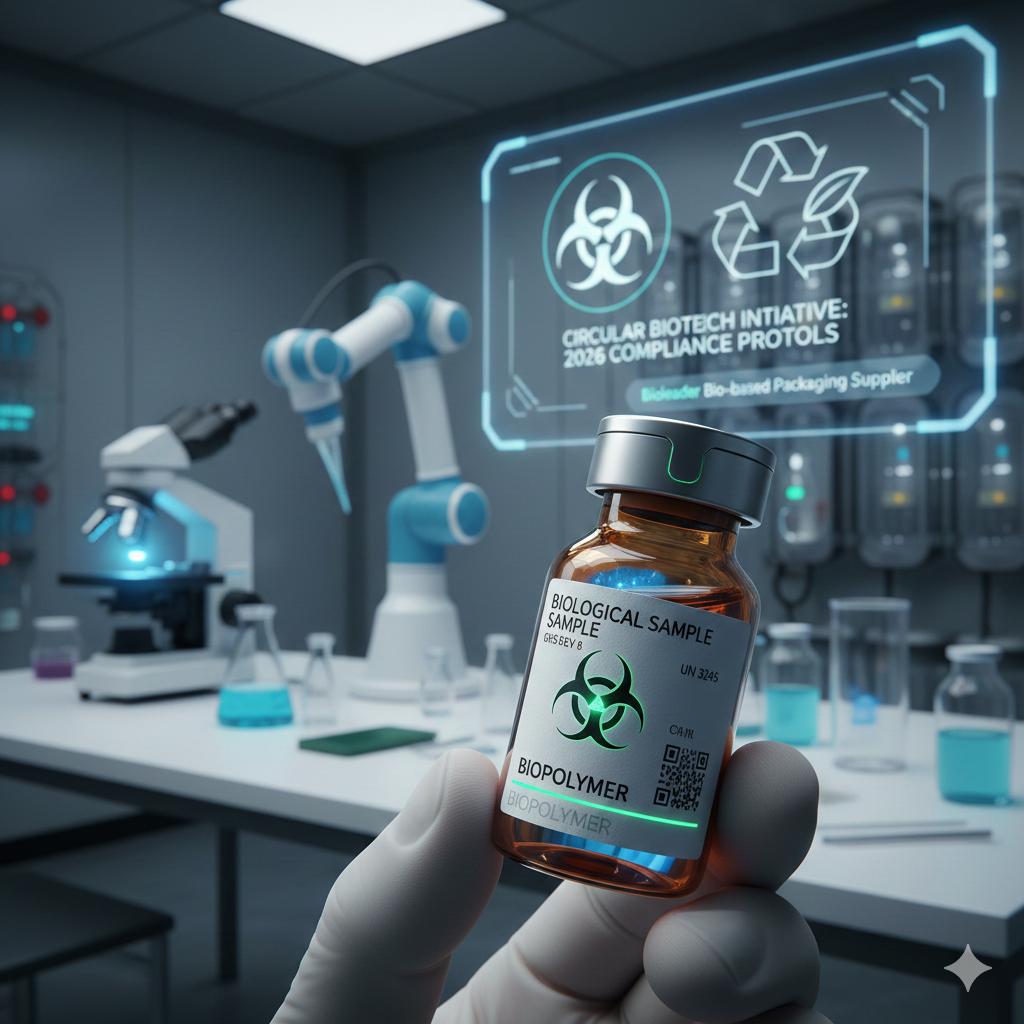
The biological sciences are defined by precision. In a laboratory or clinical setting, the margin for error is measured in microns and microliters. However, the systems that communicate these risks—biological symbols and their physical carriers—are often the most overlooked components of the bioscience infrastructure. As we move through 2026, the industry is facing a critical convergence: the tightening of global regulatory frameworks and the urgent scientific necessity to transition toward sustainable, bio-based material carriers.
This article provides a technical analysis of the evolution of biological signaling, the regulatory shifts in GHS 2026, and the polymer chemistry behind the next generation of sustainable laboratory packaging.
1. The Semiotics of Danger: Engineering the Universal Biohazard Symbol
To understand the future of biological labeling, we must first analyze the engineering of the symbols themselves. The most recognized icon in the field, the biological hazard (biohazard) symbol, is a masterclass in psychological design.
The 1966 Dow Chemical Study
Unlike the radiation trefoil, which evolved organically, the biohazard symbol was the result of a rigorous 1966 study by Dow Chemical and the NIH. The design criteria were strictly scientific:
- Unique Appearance: It had to be visually distinct from any existing safety or cultural icon.
- Symmetry: It needed to be recognizable even if partially obscured or rotated (360-degree symmetry).
- Memorable Inconsistency: It had to be “meaningless but memorable” so that its meaning could be strictly defined through training without prior cultural bias.
In 2026, this symbol remains the gold standard, but its application has evolved. We are now seeing the integration of “High-Contrast Symbols” designed specifically for machine vision and AI-driven sorting systems in automated bio-banks.
2. Regulatory Technicalities: Navigating GHS 2026 and OSHA Updates
The year 2026 marks a watershed moment for laboratory compliance. The transition to the Globally Harmonized System (GHS) Revision 7 (and the early adoption of Revision 8 in certain jurisdictions) has introduced nuanced changes to how biological and chemical hazards are classified.
Refined Hazard Classifications
The 2026 updates have refined the criteria for several key categories that directly impact bio-labeling:
- Aerosol Classification: Expansion from two to three categories, including a new “non-flammable aerosols” category that requires distinct pictograms.
- Chemicals Under Pressure: A new hazard class that necessitates specific labeling for bio-reactors and pressurized transport vessels.
- Small-Container Exemptions: New “practicality” clauses allow containers under 3ml to use abbreviated labeling, provided the secondary packaging carries the full technical disclosure.
For lab managers, the challenge is ensuring that the physical labels maintain their integrity under extreme conditions—such as liquid nitrogen immersion or autoclave sterilization—while meeting these new, text-heavy regulatory requirements.
3. The Polymer Chemistry of Labware: Beyond Petroleum
The “Bio” in biotechnology has historically been at odds with the “Plastic” in its packaging. Conventional laboratory consumables are predominantly manufactured from Polyethylene (PE) and Polypropylene (PP). While these polymers offer excellent chemical resistance, their environmental cost and carbon footprint are increasingly incompatible with the ESG (Environmental, Social, and Governance) mandates of 2026.
The Molecular Structure of Sustainable Substrates
The industry is currently shifting toward Polylactic Acid (PLA) and Polyhydroxyalkanoates (PHA). Unlike traditional plastics derived from cracked hydrocarbons, these are synthesized through the fermentation of renewable feedstocks.
Comparative Barrier Properties
In biological labeling and packaging, the Water Vapor Transmission Rate (WVTR) is the most critical metric for maintaining reagent stability.
| Polymer Type | Density (g/cm3) | Glass Transition Temp (Tg) | WVTR (g/m2/day) |
| LDPE (Traditional) | 0.92 | $-125°C$ | 10–15 |
| PLA (Standard) | 1.24 | $55-60°C$ | 18–22 |
| Bio-based PHBV | 1.25 | $0-5°C$ | 12–18 |
Scientific data suggests that while standard PLA has a higher transmission rate, new nanoclay-reinforced bio-composites are achieving parity with traditional plastics, allowing for the safe storage of hygroscopic biological powders in renewable containers.
4. Logistics and the Circular Economy in Life Sciences
The transition from a linear “extract-use-dispose” model to a circular economy requires a total reimagining of the supply chain. In the context of 2026, this means that the packaging must be as scientifically advanced as the contents it protects.
The life sciences industry is uniquely positioned to lead this change. Many reagents require secondary and tertiary packaging for thermal protection during the “cold chain” process. Replacing expanded polystyrene (EPS) with bio-based mycelium or cellulose-based insulators is a growing trend.
When organizations look to implement these changes at scale, they must partner with entities that have specialized expertise in both material science and the specific rigors of the bio-sector. Transitioning your inventory to these standards is best managed by a certified Bioleader Bio-based Packaging Supplier who can provide the necessary Life Cycle Assessment (LCA) data to validate carbon reduction claims. This technical validation is essential for passing international sustainability audits.
5. Smart Labels: The Digital-Physical Hybrid
The 2026 biological label is no longer a static piece of paper. It is a data-rich device. Smart Labeling technology is integrating biological symbols with digital identifiers to prevent the “Information Decay” that often occurs in long-term sample storage.
NFC and RFID Integration
Near-Field Communication (NFC) tags are now being embedded directly into bio-based substrates. This allows researchers to:
- Verify Chain of Custody: Automatically log every time a sample box is opened.
- Monitor Temperature Fluctuations: Use passive sensors that change the digital state of the tag if the sample exceeds a thermal threshold.
- Dynamic Labeling: Update the “Expiring” status of a reagent digitally without needing to physically re-label the vial.
The integration of these electronics into bio-based materials presents a unique recycling challenge, leading to the development of “peel-clean” adhesives that allow for the easy separation of electronic components from the compostable bio-polymer carrier.
6. Case Study: Mitigating “Leachables and Extractables” (L&E)
A significant concern in the move toward bio-based packaging is the potential for Leachables and Extractables. In a laboratory environment, any molecule that migrates from the packaging into the biological sample can ruin years of research.
Technical analysis of 2026 bio-based resins shows that high-purity PHAs exhibit lower L&E profiles than many recycled petroleum-based plastics. This is because bio-based virgin resins do not contain the complex array of antioxidants and UV stabilizers required to keep recycled PE/PP stable. For sensitive applications like cell therapy or proteomics, the move to bio-based substrates may actually increase the purity of the storage environment.
7. The Future of Visual Communication: Augmented Reality (AR) Symbols
As we look toward the end of the decade, the concept of the “symbol” is expanding into the virtual realm. Many labs are now experimenting with AR-enhanced labeling. By viewing a bio-hazard symbol through an AR headset or mobile device, a technician can see:
- The exact volume of liquid remaining.
- The specific strain of the pathogen inside.
- A 3D visualization of the emergency protocol for that specific hazard.
This layering of information ensures that the “Bio-Symbol” remains the central anchor of lab safety while providing a depth of data that was previously impossible to print on a physical label.
8. Conclusion: A Multi-Disciplinary Standard
The evolution of biological signaling in 2026 is a testament to the intersection of three distinct fields: Semiotics (the study of signs), Regulatory Law, and Polymer Chemistry. To maintain a high-functioning laboratory, one must respect the geometry of the symbols, the strictness of the GHS mandates, and the environmental impact of the packaging materials.
The shift toward sustainable substrates is no longer a peripheral concern; it is the central pillar of modern biological logistics. By moving away from petroleum-dependence and adopting the solutions provided by a dedicated Bioleader, the scientific community can ensure that its pursuit of knowledge does not come at the cost of the planet’s health.
Technical Summary for Implementation:
- Audit Frequency: Conduct semi-annual reviews of all biological labeling to stay ahead of GHS 2026/2027 revisions.
- Material Testing: When switching to bio-based packaging, perform a 90-day stability study to ensure the WVTR of the new substrate matches your reagent’s requirements.
- Data Integration: Prioritize 2D Data Matrix codes over traditional 1D barcodes to maximize space on small-vial labeling.
