

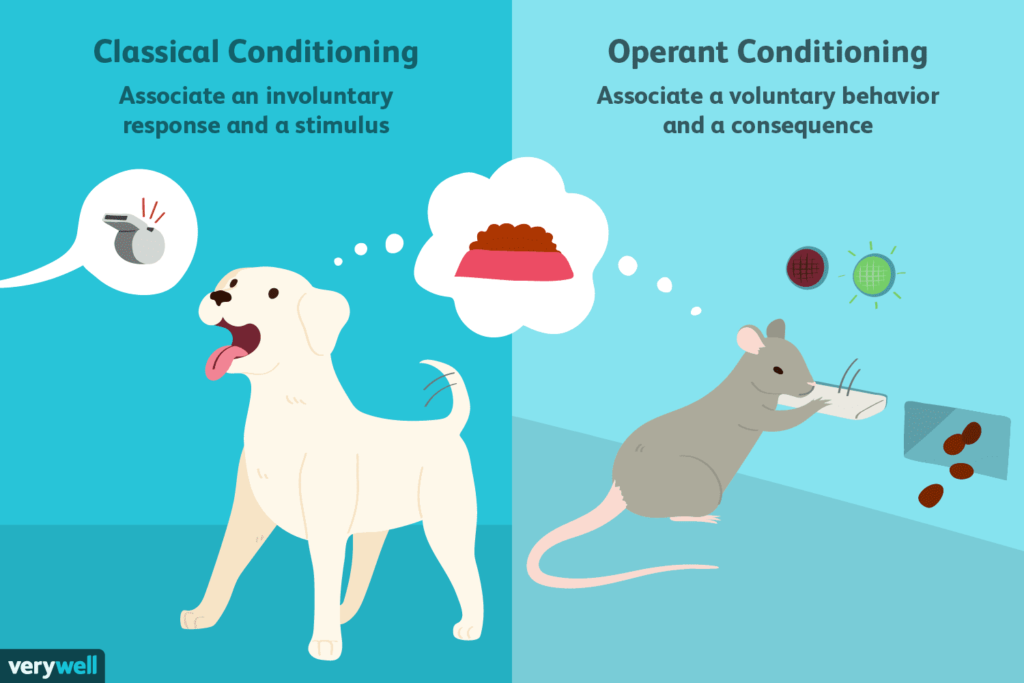
One of the significant aspects of psychology is to comprehend human behavior. Learning influences many of our actions, which are sometimes not known. The most traditional comparison of explaining this is either by operant conditioning vs classical conditioning. The two terms might appear similar but they operate at diametrically opposite ends. It would be easier to explain the reason behind why people act in a particular manner once you know how each of them operates.
Conditioning in Psychology What Is Conditioning?
Conditioning refers to the learning by experience. It describes the way human beings and the animals react to some situations in relation to the events that took place in the past. Behavior varies with time due to repetition. This learning process assists people in adjusting themselves with their environment and make decisions depending on the results. Conditioning is of two major ways. These are operant conditioning and classical conditioning. The behavior in each of them is explained differently.
What Is Classical Conditioning
Classical conditioning is the kind of learning that involves one connecting two things, which occur simultaneously. It is concerned with automatic reaction. Simply, it occurs when an ordinary stimulus is connected to a natural response. An aversive stimulus is pared with the neutral stimulus several times before beginning to cause the same reaction independently. In case a sound is constantly accompanied by food, an animal or a person can start responding to the sound only. This is not a reaction that can be controlled by choice. Rather, it is an automatic event. Due to this fact, classical conditioning is commonly associated with reflex and emotion reactions.
What Does Operant Conditioning mean?
Operant conditioning is not the same as it emphasizes on behavior and consequences. It describes how people are influenced by reward or punishments. Having such learning means that an individual makes a decision to act in a specific manner. Then, there is the consequence of the behavior which determines whether that behavior will repeat again. It is more probable that, when a positive outcome follows a behavior that is followed, it can be repeated. Conversely, when it results in a negative outcome then it can reduce. This is one way through which people will understand what will have a good or a bad result.
Underlying Major Dissimilarities in Learning Style.
Comparing operant conditioning vs classical conditioning, the primary distinction would be the process of learning. The classical conditioning is passive. The individual is not in charge of the reaction. It occurs by default following continuous exposure. Operant conditioning is being applied. This is because the individual decides and the behavior is influenced in future. Due to this, it is sometimes said that classical conditioning is related to emotional/physical responses whereas the operant conditioning is related to decision making and control of behavior.
Stimulus and Response Stimulus Role.
In classical conditioning, a response occurs in automatic response due to a stimulus. The reaction is acquired through association. In operant conditioning, the emphasis placed is made on behavior initially. The process drastically precedes the outcome. The result is then the determinant of the continuation of the behavior. Such difference might be very little, but it alters the way all forms of learning operate in real life.
Examples in Everyday Life.
The two kinds of conditioning are both witnessed in everyday scenarios. It is possible to define classical conditioning when there are some smells or sounds that evoke memories or emotions. Considering our case, listening to the particular song can be sung in the mind and awseck a feeling without any effort. Actions and consequences are considered as operant conditioning. As an example, a student who works diligently and gets praise will go on to repeat the habit. On the same note, when an individual encounters negative consequences of doing particular actions, he or she might not want to do them again. This is illustrated in these examples which display how behavior is developed as a result of learning.
Reinforcement of Behavior.
Operant conditioning much depends on reinforcement. Positive reinforcement promotes the behavior with the help of something good. Negative reinforcement also enhances behavior by eliminating something that causes negative things. On the other hand, punishment diminishes behavior. It brings in bad result or eliminates a good one. Classical conditioning is not based on reinforcement in the same respect. Rather, it relies on the repetition of association of stimuli to form a linkage.
Emotional vs Behavioral Learning.
The other distinction between operant conditioning and classical conditioning is the kind of learning involved. Classical conditioning is more concerned with emotional and automatic reaction. It describes the reason why some triggers bring feelings or response without thought. Operant conditioning is behavior centered. It is the reason why individuals decide to behave in this or that way depending on the outcomes. The two types of learning go hand in hand to influence human behavior.
The importance of these notions.
The concepts are important to understand in most aspects of life. They are applied to learning, treatment, and to discipline. As an instance, operant conditioning is applied by teachers by rewarding good behavior. Classical conditioning can be employed by therapists to make people adjust their emotional reactions. By knowing how learning works, you are able to handle the habit and enhance behavior.
Mental Health Mental health professionals can also use it.
These two forms of conditioning are relevant in mental health care. Classical conditioning can be used to describe the development of some fears or anxieties. As an example, an individual can identify a scenario with a bad experience, which will result in an automatic fear. Behavior change is commonly applied with the help of operant conditioning. The healthy habits can be influenced with the help of positive reinforcement, and the detrimental actions can be decreased consequently. All these methods contribute to long term mental health.
Difficulties in Behavior Change.
Behavioral change does not always come easy. It is possible that even people knowing about their behaviors, habits may be hard to quit. This is due to the fact that learned behaviors have a close association with past experiences. The classical conditioning as well as the operant conditioning contributes to the upkeep of such patterns. Nevertheless, change can be attained with effort and encouragement. As time passes, new patterns can be used to substitute old ones.
How these Concepts April into our lives.
You may put these thoughts into practice in the most uncomplicated ways. First, you should learn to be conscious of what elicits your reactions. This can make you have an idea of conditioning with regard to classical conditioning in your very own life. Then, you should listen to consequences. Pay attention to how an outcome or rewards determine your behavior. This is indicative of operant conditioning. With an insight into both, you can choose wiser and become more healthy.
The Reason for Raising Awareness.
As human beings are informed about operant conditioning as compared to classical conditioning, they start viewing behavior in a new light. They do not value actions; they know the learning that informs them. It is this understanding that creates more communication and more relations. It also makes blame less and empathy greater. Knowledge is not all that goes into understanding behavior. It is concerning better interaction with ourselves and others.
Final Thoughts
The classical and operant conditioning are significant in behavior formation. Where the first one is concerned with automatic responses, the second is concerned with actions and consequences. You can see the piece of the puzzle by learning how these systems work and this will give you an insight on the day to day behavior and long term habits. This is knowledge that can aid in self development and emotional studies.
Learning about these ideas is a powerful start in case you are studying the patterns of behavior or are trying to enhance mental well being. Treat Mental Health provides counseling and advice on how people could learn to understand how things work and how to establish more effective patterns to change permanently.
