

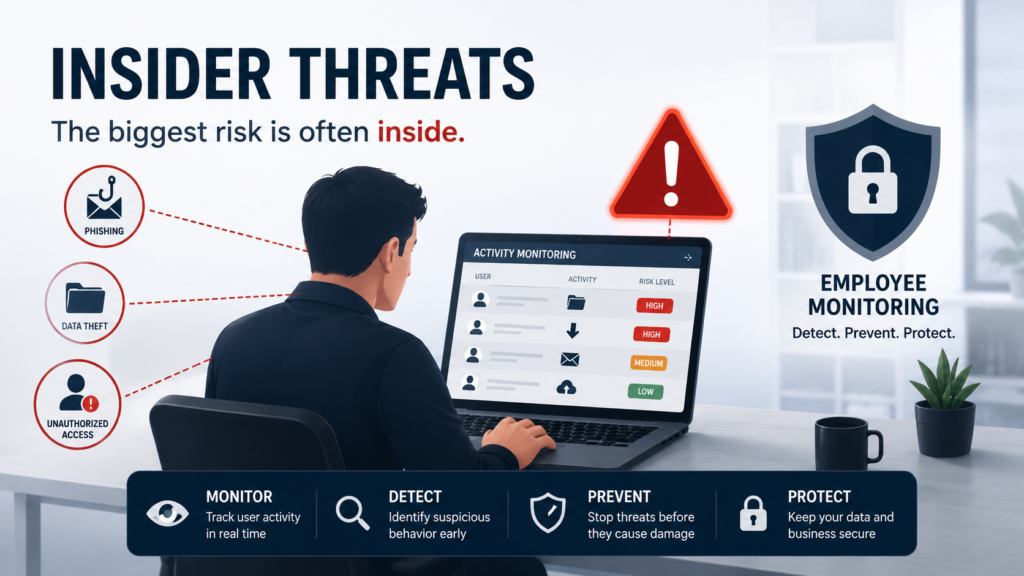
When most people picture a cyberattack, they imagine someone outside the organization, a hacker in another country, a criminal group probing for weaknesses. What they don’t picture is a trusted employee quietly copying client data to a personal drive, a contractor forwarding confidential documents to a competitor, or a well-meaning team member clicking a phishing link that hands an attacker the keys to your systems.
Insider threats are among the most damaging and least discussed risks in corporate cybersecurity. They’re harder to detect than external attacks because the people behind them already have legitimate access. They move more slowly, look more normal, and by the time the damage is visible, it’s usually been happening for months.
Employee monitoring software has become one of the primary tools businesses use to catch these threats before they become crises. Understanding how that works, and where the lines sit between security and surveillance matters for every organization managing a workforce in 2026.
What Are Insider Threats?
Definition and Types
An insider threat is any security risk that originates from within an organization, someone with authorized access who uses that access in a way that causes harm. The category breaks into three distinct types, and each requires a different response.
Malicious insiders act with intent: they’re stealing data, sabotaging systems, or monetizing their access in some way. Negligent employees cause harm without meaning to: they click phishing links, use weak passwords, share files through unsanctioned channels, or leave sensitive data exposed. Compromised users are the third category, people whose credentials have been stolen by an external actor who is now operating inside the organization, wearing someone else’s identity.
Why Insider Threats Are So Difficult to Detect
The detection problem is inherent to how insider threats work. A malicious outsider has to force their way in; an insider is already there. Their activity initially looks normal because it is normal; they’re doing things they’re permitted to do. What changes is the pattern: the timing, the volume, the specific files accessed, and the destinations where data ends up.
Without behavioral visibility, organizations have almost no way to distinguish legitimate activity from preparation for a breach until after the damage is done. The average time to detect an insider incident runs well over one hundred days, precisely because most companies lack the telemetry to catch the early signals.
Common Insider Threat Scenarios
Data theft before resignation is one of the most common patterns: an employee planning to leave copies of customer lists, proprietary code, or financial records to take to a new employer. Unauthorized file sharing, sending sensitive documents to personal email, or uploading them to consumer cloud storage, is another frequent vector. Credential misuse and compliance violations round out the picture: people accessing systems or data they have no legitimate reason to touch, often exploiting access that was granted for a different purpose and never revoked.
Why Insider Threats Are Increasing in 2026
Remote Work and Cloud Environments
The shift to distributed work fundamentally changed the insider threat landscape. When everyone worked in the same building on managed devices connected to a corporate network, unusual behavior was easier to catch. Today, employees work from home networks, personal laptops, coffee shops, and shared co-working spaces. The endpoints are harder to secure. The activity is harder to observe. The opportunities to exfiltrate data quietly are significantly more numerous.
Cloud-based work environments compounded this by multiplying the access points for sensitive data. Collaboration tools, shared drives, project management platforms, and SaaS applications each represent a potential channel through which data can leave the organization without triggering traditional security controls. Workforce monitoring that doesn’t account for these channels leaves significant blind spots.
Human Error and the Cost of Negligence
Not every insider incident involves malice. A significant proportion of data breaches trace back to employees making ordinary mistakes: reusing passwords across personal and work accounts, sharing files through unapproved tools because they’re more convenient, or failing to recognize a phishing email. These aren’t bad actors; they’re people operating under time pressure without adequate security habits.
The financial cost of both types of incidents has continued to climb. Data breach costs now factor in regulatory penalties under frameworks like GDPR and CCPA, customer notification requirements, legal exposure, and reputational damage that affects a business for years after the incident itself.
How Employee Monitoring Helps Prevent Insider Threats
Real-Time Activity Monitoring and Anomaly Detection
The core value of employee monitoring software in a security context is behavioral visibility. By tracking what users do during working hours, which applications they open, which files they access, when they log in, and how much data they move, monitoring platforms establish what normal looks like for each person. Deviations from that baseline are where the signal lives.
Real-time monitoring means those deviations surface quickly rather than weeks after the fact. An employee accessing a large volume of files they’ve never touched before, copying sensitive documents to an external drive at 11 p.m., or logging in from an unusual location while their regular session is also active, these are the kinds of patterns that trigger alerts in well-configured monitoring systems.
File Transfer and Data Loss Prevention
Monitoring file transfers and downloads is one of the most direct data loss prevention strategies available to businesses. When an employee uploads a sensitive document to a personal cloud account or connects an external drive and copies a folder of client records, that activity is visible in the monitoring log. Without that visibility, the organization may not discover the transfer until it surfaces in a competitor’s product or a regulatory investigation.
Risk scoring systems add another layer: rather than generating an alert for every unusual action, they accumulate signals over time and flag users whose cumulative behavior pattern suggests elevated risk. This reduces alert fatigue for security teams while keeping genuine threats visible.
How Employee Monitoring Software Works
Behavioral Analytics and UEBA
User and Entity Behavior Analytics (UEBA) is the technical foundation of modern insider threat detection. The system ingests data from activity monitoring, logins, file access, application usage, and network connections, and uses machine learning to build a behavioral model for each user. When activity diverges from that model, the system generates an alert proportional to the severity of the deviation.
The practical advantage over rule-based systems is adaptability. A rule that flags anyone accessing more than fifty files per hour will generate enormous false positive volumes in an organization where some roles legitimately involve high-volume file access. A behavioral model knows that a particular analyst always accesses that many files, and only flags them when their pattern changes in ways that correlate with known threat signatures.
Cloud-Based Monitoring for Remote Teams
Cloud-based employee monitoring software extends visibility to distributed workforces without requiring everyone to be on a corporate network. Activity data syncs in real time to centralized dashboards that security teams can access from anywhere. Cross-device monitoring means the system follows the user across the devices they use for work, building a complete picture rather than a partial one.
AI-Powered Employee Monitoring for Cybersecurity
From Detection to Prevention
Artificial intelligence moved insider threat detection from reactive to anticipatory. Machine learning models trained on historical breach data can identify behavioral precursors, the patterns that tend to appear in the weeks before an incident, and flag them before a breach actually occurs. An employee who suddenly starts accessing systems outside their normal scope, working unusual hours, and downloading data to external storage is exhibiting a recognizable pattern, even if no single action is definitively malicious.
Automated incident response takes this further. When a high-confidence threat alert fires, some platforms can automatically restrict the flagged user’s access, terminate an active session, or escalate to a security team in real time, compressing the window between detection and response from hours to minutes.
Employee Privacy Concerns and Ethical Monitoring
Where the Lines Sit
The capabilities of modern workforce monitoring software are significant enough that how it’s used matters enormously. Keystroke logging, screen recording, and behavioral profiling are powerful tools for detecting genuine threats, and deeply uncomfortable ones for employees who feel watched in their own homes. That discomfort is legitimate, and organizations that ignore it tend to pay for it in morale, retention, and the quality of their talent pipeline.
GDPR, CCPA, and a growing body of regional workplace surveillance law impose real constraints on monitoring. Most frameworks require explicit notice to employees, proportionality between the monitoring and its stated purpose, and meaningful limits on how long data is retained and who can access it. Organizations operating across borders need a legal review of their monitoring practices in each jurisdiction.
Transparency as the Foundation
The organizations that navigate this well share a common approach: they treat transparency as non-negotiable. Employees know what is monitored, why, and how the data is used. Monitoring is framed, and genuinely practiced, as a security measure rather than a management tool. The data collected is the minimum necessary for the stated security purpose, and it’s protected with the same rigor applied to any other sensitive asset.
Trust and security are not opposites here. A workforce that understands why monitoring exists and believes it’s being applied fairly is more likely to report suspicious behavior they observe, more likely to follow security policies, and less likely to view monitoring as adversarial.
Best Practices for Preventing Insider Threats
A Layered Approach
Behavioral analytics should anchor the strategy, but they work best as part of a layered security posture. Least-privilege access controls limit the damage any single insider can do by ensuring people can only access what they genuinely need for their role. Multi-factor authentication makes it significantly harder for compromised credentials to be exploited without detection. Regular access audits catch permissions that were granted for a specific purpose and never revoked.
Security awareness training is consistently undervalued in insider threat prevention. Many incidents that look like negligence on paper are really knowledge gaps , employees who don’t know that using personal cloud storage for work files is a security risk, or who can’t recognize a sophisticated phishing attempt. Clear cybersecurity policies and regular training change that, and the investment is modest compared to the cost of a breach.
Challenges of Employee Monitoring Software
False positives are a persistent practical problem. Behavioral analytics are good at surfacing anomalies, but anomalies aren’t automatically threats. A security team that chases every alert will burn out quickly and start filtering signals in ways that eventually cause them to miss real incidents. Tuning the system to the specific environment takes time and ongoing attention.
Employee resistance is proportional to how monitoring is introduced and communicated. Surveillance-style deployments without a clear rationale generate pushback even when the security case is strong. Over-reliance on monitoring metrics, treating activity scores as performance indicators rather than security signals, creates a separate set of problems around fairness and workplace culture that security teams often don’t anticipate.
Future Trends in Employee Monitoring and Insider Threat Detection
The trajectory of the field is toward greater intelligence with less invasiveness. Privacy-first monitoring designs anonymize individual data by default, surfacing aggregate risk patterns rather than building behavioral profiles on every employee. Zero-trust security models integrate with monitoring software to treat every access request as a potential threat, continuously verifying rather than assuming ongoing legitimacy.
Smarter behavioral analytics will reduce false positive rates further, making AI-powered threat detection more actionable and less fatiguing for the security teams who have to act on it. Predictive cybersecurity monitoring, identifying risk signals weeks before an incident rather than days after, represents the direction the best platforms are already moving.
Conclusion
Insider threats are not going away. If anything, the conditions that make them harder to detect, distributed workforces, cloud-based data access, and the blurring of work and personal devices, are becoming more entrenched, not less. Employee monitoring software is one of the most effective tools businesses have for detecting these threats early, and AI is making it significantly more capable than it was even a few years ago.
But capability without thoughtfulness creates its own risks. Monitoring that employees experience as surveillance rather than security damages the trust that holds organizations together. The businesses that handle this well treat transparency as the foundation, collect only what they genuinely need, and use the data to protect people as much as to protect assets.
The goal isn’t to watch everyone. It’s to see the things that matter before they become the kind of problem that takes years to recover from.
