

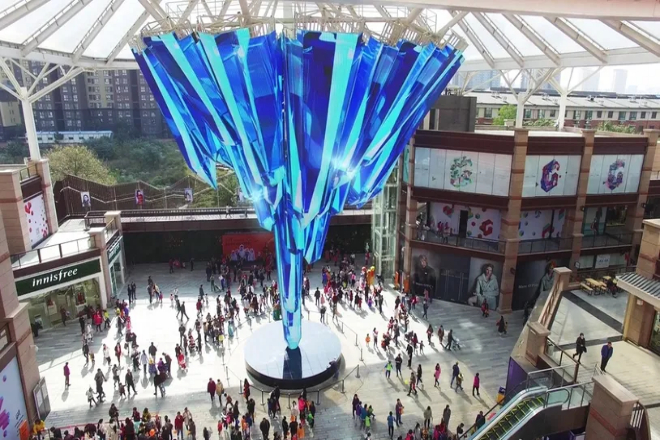
Not every LED wall needs to be a flat rectangle. Retail flagships, hotels, museums, showrooms, and entertainment venues often use LED video wall panels as part of the architecture. Curves, corners, cylinders, and irregular splicing can make a display feel built into the space rather than placed on top of it.
Start With the Shape, Not the Screen
Creative LED projects should begin with the physical environment. A curved wall in a hotel lobby has a different purpose from a corner display in a retail storefront or a cylindrical screen in a mall atrium. The shape should guide movement, frame a product, support wayfinding, or create a memorable focal point. If the form does not help the space, it can become visual clutter.
Irregular splicing means combining LED panels into nonstandard shapes or layouts. That may include staggered edges, columns, ribbons, convex curves, concave curves, or corner wraps. The display system must support alignment, content mapping, and service access for the chosen form. A creative shape is only successful if the image still looks intentional.
Businesses comparing creative commercial LED displays should involve the architect, AV designer, content team, and installer early. These projects sit between media design and interior design.
Content Must Be Designed for the Surface
Creative LED walls fail when standard landscape video is simply stretched across an unusual shape. Curved and irregular displays need content made for the geometry. A corner display may use motion that turns naturally around the edge. A cylinder may need looping graphics that feel continuous from multiple viewing angles. A narrow ribbon display may work better with texture, motion, and short messages than with normal video.
Pixel pitch, the spacing between LED pixels, should match viewing distance. Visitors may stand very close to a sculptural installation, especially in museums or retail environments. If the pitch is too wide for the distance, the form may look more technical than polished. Brightness in nits should also be controlled for comfort, particularly when a display wraps around a space where people dwell.
Refresh rate can matter when creative installations become photo or video moments. A display that looks good to the eye but flickers on camera may disappoint brands that expect user-generated content or press coverage.
Installation Details Decide the Finish
Creative forms expose details that flat walls can hide. Corners must align cleanly. Curves should avoid visible stepping unless that is part of the design language. Cylinders need careful cabinet planning so the radius looks deliberate. Irregular edges should be finished, not left looking improvised.
Service access is especially important. A failed module in the middle of a curved or sculptural wall may be hard to reach if maintenance was not considered from the start. Power, data routing, ventilation, and structural support should be part of the concept phase. The more unusual the display shape, the more important coordination becomes.
Creative LED also changes how people move through a space. A corner screen can pull attention around a storefront. A curved wall can soften a lobby. A digital column can turn unused vertical space into a branded touchpoint. In museums and temporary exhibits, irregular displays can create atmosphere without relying on traditional rectangular signage.
Esdlumen’sEsdlumen commercial LED display range is a useful starting point for teams thinking beyond standard wall formats. The strongest creative LED projects are not unusual for the sake of being unusual. They use shape, content, and installation craft to make the display feel like it belongs exactly where it is.
