

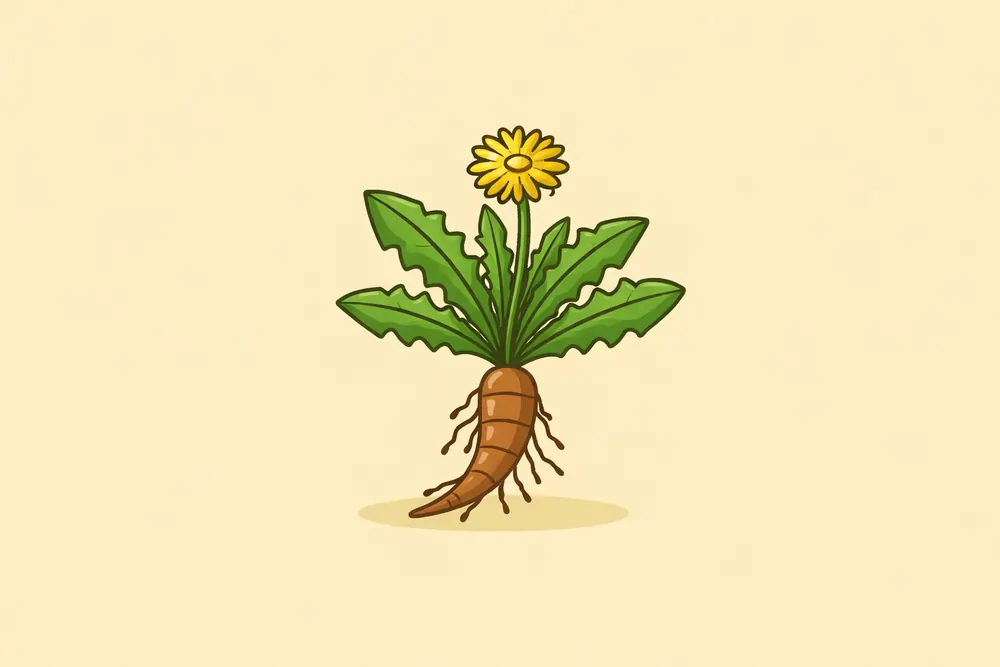
In the herbal world, dandelion root vs leaf is not a small detail. It changes the chemistry, the traditional use, and the safety “watch-outs.” This article gives a practical, research-aware comparison of Taraxacum officinale leaf (greens, leaf tea, extracts) versus root (roasted root drinks, root tea, extracts). You’ll also get a simple selection checklist and clear cautions—without disease claims or hype.
What are dandelion “leaf” and “root” in supplement terms?
Dandelion products usually come from two plant parts:
- Leaf (Taraxaci folium): the green leaf. Often sold as dried leaf tea, fresh juice, capsules, or liquid extracts.
- Root (Taraxaci radix / Taraxaci officinalis radix): the root. Often used as dried root tea or roasted “coffee-style” beverage, plus extracts and capsules.
If a label only says “dandelion” without specifying leaf or root, you’re guessing. For consistent expectations, look for Taraxacum officinale and the plant part.
Why do people compare dandelion root vs leaf?
Most people compare them for three reasons:
- Different dominant compoundsLeaf is nutrient-dense as a food; root is more associated with inulin/fructans and “roasted root beverage” tradition.
- Different “feel” and timingLeaf preparations are commonly used in routines tied to fluid balance (traditional diuretic use), while root is often chosen for digestive “bitter” routines and roasted flavor.
- Different safety flagsBoth have cautions (Asteraceae allergy, pregnancy/lactation uncertainty), but the practical concerns differ depending on form, dose, and your meds.
What’s the biggest chemical difference between leaf and root?
Leaf: more “food-like” nutrient density
As a food, dandelion greens are notable for vitamins and minerals. For example, USDA-based nutrition data for raw dandelion greens show 25 calories per 100 g and very high vitamin K (hundreds of micrograms per 100 g) plus vitamin A (hundreds of mcg RAE per 100 g).
That matters if you use leaf as food (salads, cooked greens) or leaf powder—especially if you’re on medications affected by vitamin K intake (more on that in safety).
Root: more inulin/fructans and roasted beverage tradition
Root is often discussed as a source of inulin-type fructans (a prebiotic fiber family) and is commonly roasted for a coffee-like drink. Reviews of dandelion chemistry highlight inulin presence in roots, and analytical work reports substantial inulin/fructan content in root material.
Table 1: Dandelion root vs leaf at a glance
| Feature | Dandelion leaf (folium) | Dandelion root (radix) |
|---|---|---|
| What it “behaves like” | Food + herbal leaf | Fiber-rich root + roasted beverage |
| Typical forms | Leaf tea, fresh greens, juice, extracts | Root tea, roasted root drink, extracts |
| What stands out | High vitamin K/A as food; traditional diuretic use | Inulin/fructans; roasted flavor; traditional digestive/bitter use |
| Evidence signal | Small human pilot suggests diuretic effect for leaf extract | Evidence is broader on chemistry; limited human clinical endpoints for root in common use |
| Main caution themes | Fluid balance routines; vitamin-K-sensitive meds | GI tolerance (fiber); bile-flow/gallbladder cautions in traditional frameworks |
Sources: leaf monograph + human pilot + nutrition data + root chemistry reviews.
What does human research suggest for leaf?
Leaf has one of the clearer human signals in the dandelion literature: a small pilot study in healthy volunteers reported increased urination frequency and fluid excretion metrics after a fresh leaf hydroethanolic extract. It’s not the same as leaf tea, and it’s not a “proof of benefit,” but it’s a real human data point.
Practical takeaway:
- Leaf extract showed diuretic-like effects in a pilot context.
- That does not mean “more is better,” and it does not justify medical claims.
What does research suggest for root?
Root research is stronger on composition (polysaccharides like inulin/fructans, phenolics) than on direct “this improves X outcome” in large, well-controlled human trials.
A recent review summarizes dandelion genus chemistry and highlights different compound profiles across plant parts, including root constituents and polysaccharides.
Practical takeaway:
- Root is a reasonable choice when your goal is a non-caffeinated roasted beverage or a fiber-forward botanical.
- People with sensitive digestion may need to start low because prebiotic fibers can cause gas/bloating in some individuals.
How do traditional monographs position leaf vs root?
Regulatory-style monographs don’t “prove” efficacy, but they summarize traditional patterns, contraindications, and labeling logic.
- EMA leaf monograph (Taraxaci folium): frames traditional use and lists important precautions (including bile duct obstruction and pregnancy/lactation not recommended due to insufficient data).
- EMA root monograph (Taraxaci officinalis radix): provides EU herbal monograph context for root preparations and their traditional use framing.
- Health Canada monograph (2025): provides modern label-claim structure for dandelion and emphasizes how “traditional use” claims should be presented.
What should a beginner choose: root or leaf?
Choose leaf when your goal is “greens + gentle herbal leaf routine”
Leaf makes sense if you:
- want a nutrient-dense food (greens), or
- prefer lighter herbal teas, or
- are specifically comparing “leaf tea” routines.
Choose root when your goal is “roasted drink + fiber-forward botanical”
Root makes sense if you:
- want a coffee-like roasted beverage without caffeine, or
- want the root profile that’s often associated with inulin/fructans.
Statistics block
- Raw dandelion greens: about 25 kcal per 100 g (USDA-based data).
- Vitamin K in raw dandelion greens: approximately 778 µg per 100 g (USDA-based data).
- Leaf diuretic pilot: published human trial reporting increased fluid excretion measures after dandelion leaf extract (small sample; pilot design).
Safety: what are the real watch-outs?
This is YMYL-adjacent because people use dandelion for health goals. So the safest framing is “who should be cautious,” not “what it treats.”
Avoid or ask a clinician first if any of these apply
- Pregnancy and lactation: EMA leaf monograph states safety is not established and use is not recommended due to insufficient data.
- Bile duct obstruction / cholangitis / certain liver or gallbladder conditions: EMA leaf monograph lists these as contraindications/precautions in the traditional framework.
- Asteraceae allergy (ragweed family): dandelion is in Asteraceae; allergic cross-reactivity can occur.
- Lithium: EMA assessment report discusses a theoretical risk: diuretic-acting herbs may contribute to dehydration and lithium toxicity risk. Don’t self-experiment here.
Also remember: “natural” does not mean “interaction-free.” NCCIH explicitly flags supplement–medication interactions as a general risk area.
Checklist: picking the right form and avoiding rookie mistakes
- I can name the plant part: leaf (folium) or root (radix).
- I’m not pregnant/breastfeeding, or I’ve cleared it with a clinician.
- I don’t have bile duct obstruction/gallbladder issues that monographs flag for caution.
- If I take lithium, I’m not using this without medical supervision.
- I start with a small serving and watch tolerance, especially with root (fiber).
- I’m not using dandelion as a replacement for medical care.
How do tea and extract differ for dandelion?
Tea and extracts are not interchangeable:
- Tea (infusion/decoction) tends to be less concentrated and varies by brew time, plant cut, and dose.
- Extracts can deliver higher and more consistent concentrations, which can raise both “effect” and interaction potential.
The leaf diuretic pilot used a hydroethanolic extract, not a casual tea. That distinction matters.
Dandelion root vs leaf | FAQ
Is dandelion leaf or root better?
Neither is “better.” Leaf fits food-like greens and leaf tea routines, while root fits roasted beverages and fiber-forward profiles.
Does dandelion leaf act like a diuretic?
A small human pilot study found a diuretic-like effect from a dandelion leaf extract. Tea is not the same as that extract.
Does dandelion root contain inulin?
Reviews and analytical research report substantial inulin/fructans in dandelion roots, which supports its “prebiotic fiber” reputation.
Who should avoid dandelion products?
People who are pregnant/breastfeeding, those with bile duct obstruction or certain gallbladder issues, those with Asteraceae allergy, and people on lithium should be cautious and consult a clinician.
Can I take dandelion with medications?
Interactions are possible. A key example is lithium risk in the context of diuretic-acting herbs. Ask a clinician/pharmacist if you take prescriptions.
Glossary
- Taraxacum officinale: the most common scientific name for dandelion used in supplements.
- Taraxaci folium: dandelion leaf (pharmacopoeial/monograph term).
- Taraxaci radix: dandelion root (monograph term).
- Inulin / fructans: prebiotic fiber group often reported in dandelion roots.
- Asteraceae: plant family; relevant for allergy cross-reactivity.
- Hydroethanolic extract: alcohol-water extraction used in the leaf diuretic pilot.
- HMPC (EMA): EU committee that publishes herbal monographs.
Conclusion
Dandelion root vs leaf is a real choice: leaf leans food-like and has a small human diuretic signal in extract form, while root leans fiber/roasted-beverage tradition and inulin/fructans. Pick the plant part to match your goal, and respect the safety flags.
Sources
- NCCIH. “Dandelion: Usefulness and Safety.” (accessed 2026). nccih.nih.gov/health/dandelion
- EMA HMPC. “Final community herbal monograph: Taraxacum officinale… folium.” 2009/2011. ema.europa.eu/…/final-community-herbal-monograph-taraxacum-officinale-weber-ex-wigg-folium_en.pdf
- EMA HMPC. “Taraxaci officinalis radix – herbal medicinal product page (EU monograph).” 2022. ema.europa.eu/en/medicines/herbal/taraxaci-officinalis-radix
- Clare BA et al. “The diuretic effect in human subjects…” 2009. pmc.ncbi.nlm.nih.gov/articles/PMC3155102/
- EMA HMPC. “Assessment report: Taraxacum officinale… radix cum herba.” 2009. ema.europa.eu/…/final-assessment-report-taraxacum-officinale-weber-ex-wigg-radix-cum-herba_en.pdf
- Fan M et al. “Dandelion (Taraxacum Genus): A Review…” 2023. pmc.ncbi.nlm.nih.gov/articles/PMC10343869/
- Kania-Dobrowolska M et al. “Dandelion… as a Source of…” 2022. pmc.ncbi.nlm.nih.gov/articles/PMC9498421/
- Savych AO et al. “Analysis of inulin and fructans in Taraxacum officinale…” 2021. pharmacia.pensoft.net/article/66266/
- MyFoodData (USDA-based). “Nutrition Facts for Raw Dandelion Greens (fdcid 169226).” (accessed 2026). tools.myfooddata.com/nutrition-facts/169226/
- Health Canada. “Dandelion (Taraxacum officinale) monograph.” 2025. webprod.hc-sc.gc.ca/…/mono_dandelion–taraxacum-officinale_english.pdf
