

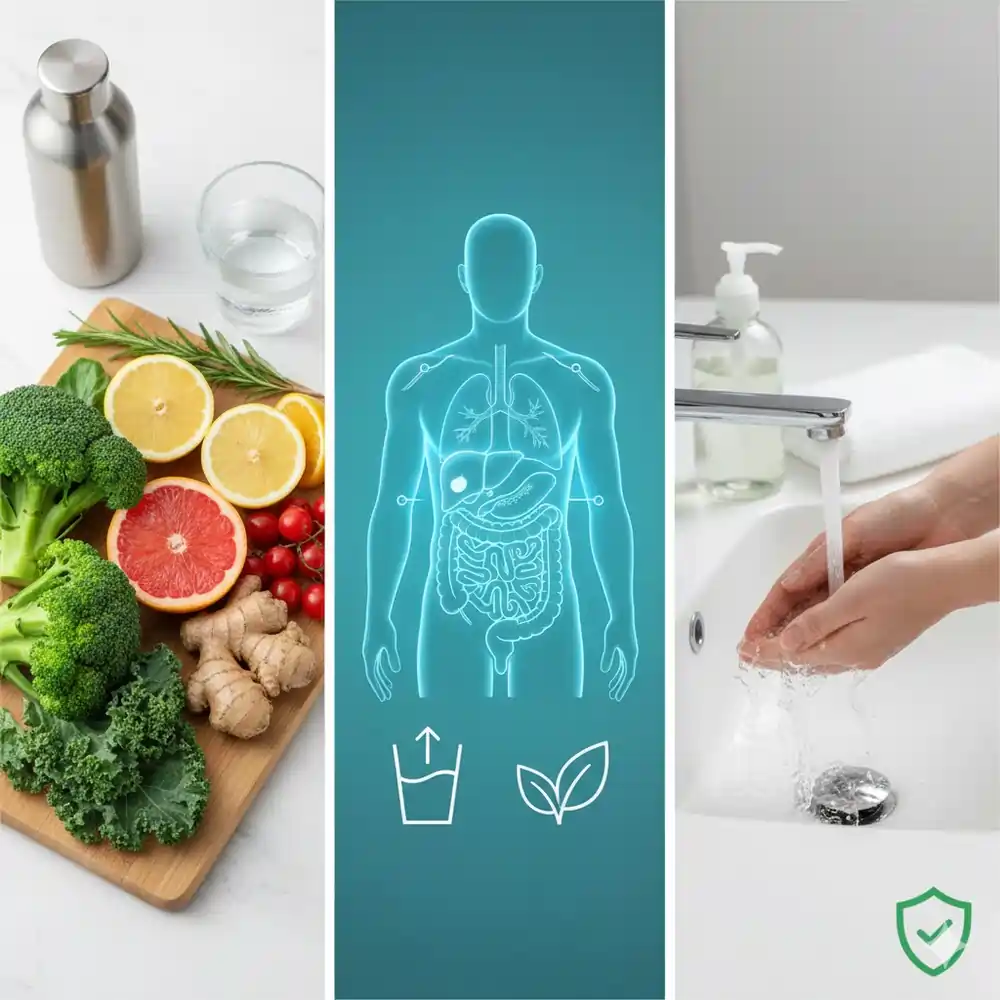
If you’re searching for signs you need to detox your body, you’re probably feeling “off” and want a clear fix. That’s understandable. But here’s the key point: your body already “detoxes” 24/7 through your liver, kidneys, lungs, skin, and gut. Claims that a cleanse removes toxins are usually vague, and the evidence behind most detox programs is limited or inconsistent.
So what should you do instead? Use symptoms as signals to check basics (sleep, diet quality, hydration, stress, alcohol, meds) and to spot red flags that need medical attention.
Do you actually need a “detox”?
Most detox marketing uses “toxins” without naming the chemical, the dose, or a measured improvement. That’s a problem. Medical detox is a real thing (e.g., supervised withdrawal), but “detox diets/cleanses” are different—and evidence for broad health claims is weak.
What your body does have is a built-in system:
- The liver transforms many compounds into forms the body can eliminate.
- The kidneys filter blood and remove waste through urine (and fluid balance matters).
- The gut moves waste out; fiber supports regularity and microbiome function.
A “detox” is rarely what you need. A reset of inputs often is.
What are common “detox signs” and what else could they be?
Many symptoms blamed on “toxins” have simpler explanations. Use this table to self-triage.
Quick reality-check table (symptom → common causes → when to worry)
| Symptom people call “toxins” | Common, non-detox explanations | When to seek medical advice |
|---|---|---|
| Fatigue, low energy | Poor sleep, low iron, thyroid issues, depression/anxiety, overtraining, calorie restriction | Severe, persistent (>2–3 weeks), shortness of breath, chest pain, fainting |
| Brain fog, headaches | Dehydration, poor sleep, high stress, caffeine swings, screen load | Sudden “worst headache,” neurological symptoms, head injury |
| Bloating, constipation | Low fiber, low fluids, ultra-processed diet, IBS triggers | Blood in stool, unexplained weight loss, persistent severe pain |
| Skin breakouts | Hormonal shifts, stress, cosmetics/irritants, diet patterns | Widespread rash, fever, swelling, blistering |
| Bad breath | Dry mouth, reflux, dental issues | Persistent + pain, fever, swallowing difficulty |
| Cravings, mood swings | Sleep debt, unstable meals, high added sugar patterns | If tied to disordered eating or significant mood changes |
| “Water retention” | Sodium swings, menstrual cycle, inactivity | New swelling in one leg, shortness of breath, chest pain |
This isn’t a diagnosis. It’s a smarter starting point: fix foundations first, and watch what changes.
Which “signs” should trigger medical advice now?
Do not try to cleanse your way through these. Get checked:
- Yellowing skin/eyes (jaundice), very dark urine, pale stools
- Persistent vomiting, severe diarrhea, dehydration
- Chest pain, palpitations, fainting
- Blood in stool or vomit
- Unexplained weight loss, fever, night sweats
- Severe abdominal pain, especially right upper abdomen
- Confusion, weakness on one side, speech changes
If you have kidney disease, heart disease, GI disease, or a history of colon surgery, be extra cautious with “cleanses” and colon products.
What habits actually support your body’s detox systems?
These are boring. They also work.
1) Eat enough fiber (most people don’t)
Guidelines commonly translate to ~14 g fiber per 1,000 calories (≈28 g on a 2,000-calorie pattern).
But measured intake is often far lower. In U.S. NHANES 2009–2010, average intake was ~16 g/day.
Higher fiber intake links to better long-term outcomes in large analyses.
Practical move: add 1 fiber “anchor” per meal (beans/lentils, oats, chia/flax, berries, vegetables, whole grains). Increase gradually.
2) Hydrate consistently (don’t overdo it)
A commonly cited adequate intake for total water is about 3.7 L/day for men and 2.7 L/day for women (from all beverages + food).
Individual needs vary with climate, activity, and health conditions.
Practical move: aim for pale-yellow urine, add fluids with fiber, and increase during heat/exercise.
3) Prioritize sleep (it’s not optional)
Poor sleep amplifies fatigue, cravings, headaches, and perceived “toxicity.” Fix sleep before buying products.
Practical move: consistent wake time, morning daylight, caffeine cutoff, and a 30–60 minute wind-down.
4) Limit alcohol “catch-up”
Alcohol changes how the liver prioritizes metabolism and can worsen sleep and GI symptoms. A “detox” after binge drinking is not a plan—hydration, food, rest, and time are.
Are detox cleanses, juice fasts, and colon cleanses safe?
Often, the risk is higher than people expect.
Colon cleanses / colonic irrigation
Evidence for benefits is limited, and side effects can be serious—especially in people with certain GI, kidney, or heart conditions.
Juice cleanses and extreme restriction
You might lose weight short-term mostly from calorie restriction and water shifts. That doesn’t prove “toxin removal.”
Extreme restriction can also worsen headaches, sleep, dizziness, and binge–restrict cycles.
Comparison table: “detox” methods vs safer alternatives
| Popular method | Main concern | Safer alternative |
|---|---|---|
| Juice-only cleanse | Low protein/fiber, energy crash | Add vegetables + protein + fiber daily |
| Laxatives/diuretics “flush” | Dehydration/electrolyte risk | Hydration + fiber + movement |
| Colon cleanse/colonic | Potential complications in risk groups | Regular meals + fiber targets |
| Multi-ingredient “detox” stacks | Unknown interactions, adverse events | Single-change experiments, clinician review |
For most people, “detox symptoms” are often “not enough sleep + low fiber + inconsistent hydration + stress.”
What about herbs and “detox” supplements?
People search for herbs for body cleanse because it sounds natural and simple. But “natural” doesn’t guarantee safe, effective, or compatible with your meds.
What you can do safely:
- Treat herbal products as supplements, not cures. U.S. labeling rules require disclaimers and restrict disease claims.
- Avoid products that promise to “clean toxins,” “flush heavy metals,” or “heal the liver.” Those are red-flag claims.
- Prefer food-first support (fiber-rich plants) because evidence is stronger and risks are lower.
- If you still want a supplement: choose one, check third-party quality testing, and review meds/conditions with a clinician.
Stats you should know
- Fiber gap: recommended patterns often land around ~28 g/day for a 2,000-calorie diet, but observed intake can be ~16 g/day in survey data.
- Evidence gap for cleanses: major health sources note limited/insufficient evidence for many detox/cleanse claims and highlight potential harms for some practices.
Checklist: a safe 7-day “reset”
Daily
- ☐ Add 1 high-fiber food at each meal (beans, oats, berries, vegetables, whole grains).
- ☐ Drink fluids steadily; increase with fiber and activity.
- ☐ Eat protein each meal (supports satiety and stable energy).
- ☐ Walk 20–30 minutes or do light movement.
- ☐ Keep caffeine consistent; avoid late-day spikes.
- ☐ Add herbal blends for daily routines.
- ☐ Sleep with a fixed wake time.
Avoid for 7 days
- ☐ Juice-only days, laxatives/diuretics for “cleansing”
- ☐ New multi-ingredient supplement stacks
- ☐ Colon cleanse products unless specifically advised by a clinician
Track
- Energy (AM/PM), stool consistency, bloating, sleep hours, and 1–2 meals/day. Patterns beat guesses.
Signs You Need to Detox Your Body | FAQ
1) What are the real signs you “need a detox”?
Most are signs you need better sleep, more fiber, steady hydration, and less alcohol/ultra-processed food—not a cleanse.
2) Do detox diets remove toxins from the body?
There’s limited evidence that detox diets meaningfully remove unspecified “toxins” in healthy people. Your organs already handle elimination.
3) Why do I feel worse on a cleanse?
Low calories, low protein, low fiber, caffeine withdrawal, and dehydration can cause headaches, fatigue, and irritability.
4) Is colon cleansing a good idea?
Not for most people. Medical sources warn about possible side effects and higher risks in people with GI, kidney, or heart conditions.
5) Are “detox” supplements safer than detox diets?
Not automatically. Supplements can cause adverse events and interact with medications; large studies have linked supplements to emergency visits.
6) What’s the safest way to support natural detox pathways?
Fiber-rich foods, adequate fluids, sleep, regular movement, and avoiding risky cleanse practices.
Glossary
- Detoxification (physiology): Enzymatic processing that helps transform compounds for elimination, largely in the liver.
- Xenobiotics: Foreign compounds (drugs, pollutants) processed by the body’s metabolic systems.
- Cytochrome P450 (CYP): A major enzyme family involved in Phase I metabolism.
- Phase I / Phase II: Steps in metabolic processing that can modify compounds and increase water solubility.
- Glutathione: A key antioxidant system involved in cellular protection and metabolism.
- Microbiome: Community of gut microbes that interacts with diet, fiber, and gut function.
- DSHEA disclaimer: Required U.S. supplement disclaimer limiting disease claims.
- Colonic irrigation: Colon cleansing procedure with limited evidence and potential risks in certain groups.
Conclusion
Most “detox signs” are your body asking for fundamentals: sleep, fiber, hydration, and fewer extremes.
Sources
- NIH National Center for Complementary and Integrative Health (NCCIH). 2024. “Detoxes and Cleanses: What You Need To Know.” https://www.nccih.nih.gov/health/detoxes-and-cleanses-what-you-need-to-know
- Harvard Health Publishing. 2020. “What’s being cleansed in a detox cleanse?” https://www.health.harvard.edu/blog/harvard-health-ad-watch-whats-being-cleansed-in-a-detox-cleanse-2020032519294
- U.S. Food and Drug Administration (FDA). 2025. “Letter to the Dietary Supplement Industry on the DSHEA Disclaimer.” https://www.fda.gov/food/information-industry-dietary-supplements/letter-dietary-supplement-industry-dshea-disclaimer
- U.S. Food and Drug Administration (FDA). 2024. “Questions and Answers on Dietary Supplements.” https://www.fda.gov/food/information-consumers-using-dietary-supplements/questions-and-answers-dietary-supplements
- Geller AI, et al. 2015. “Emergency Department Visits for Adverse Events Related to Dietary Supplements.” New England Journal of Medicine. https://www.nejm.org/doi/full/10.1056/NEJMsa1504267
- USDA Agricultural Research Service. 2014. “Dietary Fiber Intake of the U.S. Population (NHANES 2009–2010).” https://www.ars.usda.gov/arsuserfiles/80400530/pdf/dbrief/12_fiber_intake_0910.pdf
- U.S. Dept. of Agriculture & U.S. Dept. of Health and Human Services. 2020. “Dietary Guidelines for Americans, 2020–2025.” https://www.dietaryguidelines.gov/sites/default/files/2020-12/Dietary_Guidelines_for_Americans_2020-2025.pdf
- National Academies of Sciences, Engineering, and Medicine. 2004. “Dietary Reference Intakes for Water…” (AI: 3.7 L men, 2.7 L women). https://www.nationalacademies.org/read/10925/chapter/2
- Reynolds A, et al. 2019. “Carbohydrate quality and human health…” The Lancet / PubMed record. https://pubmed.ncbi.nlm.nih.gov/30638909/
- Mayo Clinic. 2024. “Colon cleansing: Is it helpful or harmful?” https://www.mayoclinic.org/healthy-lifestyle/consumer-health/expert-answers/colon-cleansing/faq-20058435
- NCBI Bookshelf (StatPearls). 2023. “Physiology, Liver.” https://www.ncbi.nlm.nih.gov/books/NBK535438/
