

Introduction -Move towards Digital Learning in Early Years.
The last several years have seen the dramatic change of paradigms of digital learning that is no longer the supplementary one but rather the strategic one in the global education environment. This transformation highlights early childhood as a strategic stage of the edtech trends in the world. In this case, early childhood immersive learning becomes a developing trend that changes the orientation of preschool education towards innovative methods.
Preschools are on the forefront in the preschool’s new digital transformation involving the combination of play-based learning and technology. Significant studies contribute to this development, where preschools are the best places to explore the digital tools owing to the nature of short attention span, enthusiasm towards hands-on learning, and effective parent-teacher feedback loops.
EdTech Global EdTech Landscape – Current Trends, Investment.
The trends in edtech in the world demonstrate the general strategies that influence this field. In this case, system-wide strategies shine brighter than individual pilots, who guide changes in technology tools in early childhood. Individualized teaching and teaching-based on data are in the vanguard with hybrid teaching models, which combine physical classroom experiences with online interactive approaches (and where teaching practices are improved).
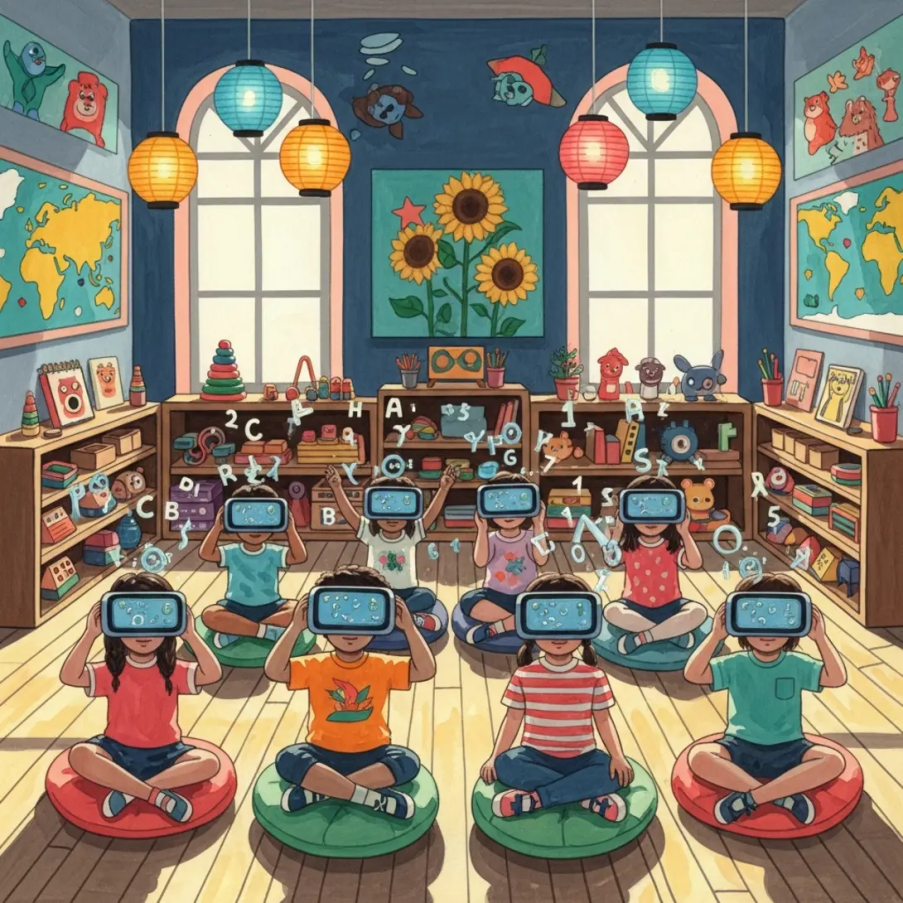
These trends include virtual reality in pre-schools, which is increasingly becoming popular, with the integration of immersive technologies to bring more value to the learning process. As the number of investments made to develop fundamental skills in the mind during the early years increases significantly, the spotlight has shifted to early childhood as a period that is a significant milestone in learning. Innovations in preschool learning are dictating the future levels, which investors are eager to support in order to bring forth meaningful long-term results.
The role of Early Childhood Education- Tech Uptake in Preschools.
Preschools are the first to embrace the use of edtech solutions due to their distinctive ecosystem and driven by critical neuroscience understanding. Neuroscience highlights ages 0-6 years as being rich with brain development, which is especially where immersive learning for early childhood can significantly increase language and social skills. Digital technology further this objective through improving parent teacher interactions, which is critical to Preschool Digital Transformation.
These tools also facilitate teachers with rapid evaluation, individualized actions and real-time progress distribution which are pillars of early childhood technology tools. Moreover, early childhood digital learning (via mobile-first strategies) in underserved regions can be greatly improved by narrowing the gap between digital content and workflow, through tailored content targeted at short, playful, multimedia experiences.
Technologies in Preschool EdTech – Apps, Immersive Learning, Tools.
Digitizing Preschool Management/Admin.
The digital innovations bring dynamic solutions to the operations of the preschool like the preschool management apps like BubbleBud Kids that simplify the administrative work, increase communication with parents, and make it easier to track activities. The steps mentioned above play a significant role in facilitating the digital transformation of preschool education by liberating teachers to provide learners with more interactive learning and enhancing these experiences with data analytics to allocate their resources more efficiently.
Preschool Learning Management system (LMS)
A responsive preschool LMS, which is available at BubbleBud Kids, embraces online learning in early childhood as a means of providing structured digital content, tracking progress, and extensions to the home. The systems support short attention spans and these systems foster a symbiotic parent-teacher relationship which ensures that children excel both at school and at home.
Total engagement and intelligent learning.
Virtual reality in preschools is also provided by technological improvements and is presented in the form of Smart Classroom Solutions in India that provide the simulation of adventures and immersion. Ranging in complexity between basic instruments such as projectors and audio, to the complex VR headsets, these devices enhance engagement and deeper learning because they engage the preschoolers within the imaginative setting of a story telling.
Early Childhood Technologies and Experiences.
Early childhood technology has offered a multiplicity of digital stories, audio-guided mindfulness, and what can be termed code-switching through the use of digital stories through coding games and audio-guided mindfulness, all of which are designed to support early childhood digital learning. The wise use of coupling screen time with sport activities is their proper place in ensuring an overall positive impact on the holistic development of these interactive experiences.
Barriers and Opportunities Accessibility, Training, Costs
The digital transformation of the preschool, though potentially, is a challenge with certain difficulties especially in resource-strained environments where device and connectivity disparity still exist. There is also the issue of low access to high-level early childhood technology because of budget constraints. Also, a small number of educators are also reluctant about immersive learning in early childhood, and they tend to refer to lack of training or fear of technology to take over the traditional method.
However, there exist prospects especially with mobile-first and low-bandwidth solutions growing to support Early Childhood Digital Learning in rural areas. Integrated systems, as Commonwealth weldon preschool management where LMS, and are an exemplar of how integrated systems provide a great user experience that also integrates administration with instruction. Localization, which involves paying attention to a wide range of languages and cultural peculiarities, further tailors these learning experiences and increases the level of child interaction and performance.
The India Advantage Case Studies and Local Innovations.
India is a unique environment, ready to undergo digital conversion in preschool education that is enhanced by massive mobile connection that would facilitate digital learning across socio-economic borders. The focus on foundational literacy and numeracy is in line with the virtual reality in the preschools and other immersion tools.
Case studies depict such innovations, and Smart Classroom Solutions in India offers simulated adventure of classrooms at a low cost with the use of simple technology set ups. These local solutions underline the aspects of affordability and scalability: which are features that can be tailored to other emerging markets worldwide.
In Conclusion -Early Childhood Education as the Change Agent of Global EdTech.
To conclude, the edtech revolution all over the world is preschools whose heartbeat is a blend of technology, play, inclusiveness, and developmental congruence. Such tools as preschool management applications and interactive learning management system, as well as virtual learning worlds, start influencing education even earlier in life.
The strategic efforts of India serve as a good example of how the innovation in the technology of preschools and early childhood digital learning can become a leader in changes at the international level. These paradigms are likely to transform the face of learning as these interactive learning experiences are replaced with subtle virtual reality in preschools, and early childhood education becomes a force behind the edtech revolution.
FAQ
Q: Why is early childhood regarded as an important point of EdTech adoption?
A: Neuroscience emphasizes the age group 0-6 as being crucial to the development of the brain. These formative years can be very helpful in teaching language, social and cognitive skills through the use of digital tools and immersive learning.
Q: What are the benefits of technology integration in preschools?
A: Technology makes the administration easier, provides easy communication of parents and teachers and enhances interactive learning. This synergy assists in developing the well-rounded development outcomes.
Q: In which ways are even more hindrances in the preschool digital transformation?
A: There are still issues of budgetary limitations, low connection, and reluctance of educators. Mobile-first and low-bandwidth solutions are however filling the gaps particularly in remote areas.
Q: Why is India relevant to the global EdTech trends?
A: India has a high level of mobile penetration, a substantial population of children of preschool age, and economical local innovations that make it an important pilot to successful Edtech solutions that have global applicability.
