

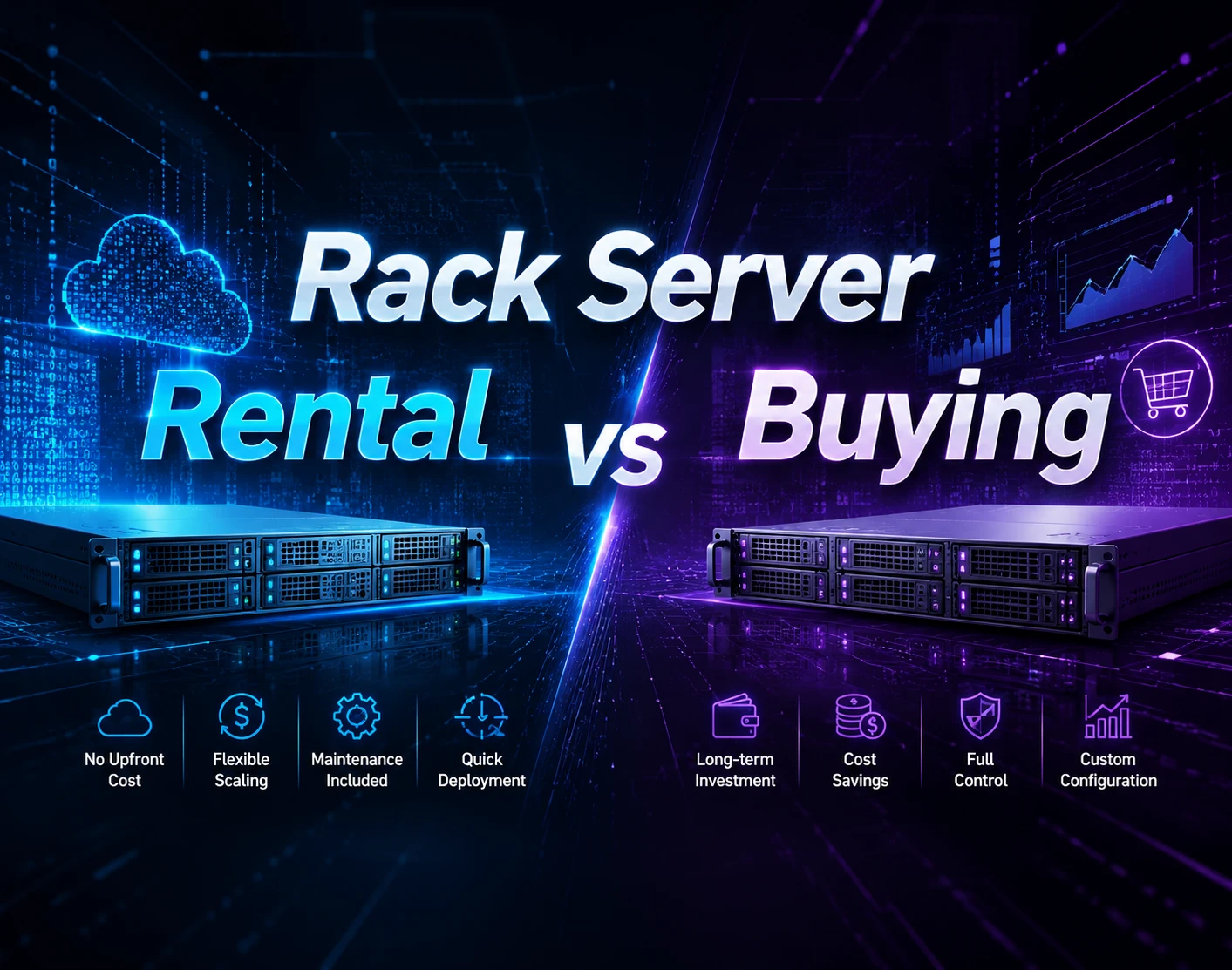
When building IT infrastructure, companies eventually face a key decision: rent rack servers or purchase their own hardware. At first glance, the decision seems simple and comes down to comparing monthly rental costs with upfront capital expenditure. In many cases, rack server rental becomes the preferred option for businesses seeking flexibility and lower initial investment.
In reality, however, the difference between these models goes much deeper, affecting not only cost but also flexibility, scalability, operational expenses, and the overall speed of business growth.
In this article, we will explore when rack server rental is the more strategic choice and when owning infrastructure provides long-term advantages.
What Rack Server Rental and Buying Mean
Rack server rental is a model in which a company rents server hardware or colocation space in a data center and pays for infrastructure on a subscription or fixed pricing basis. This can include dedicated servers as well as full rack colocation services.
Buying, on the other hand, means purchasing physical hardware, installing it in owned or rented data center space, and managing its full lifecycle internally.
Essentially, these represent two different financial approaches: operating expenditure (OPEX) and capital expenditure (CAPEX).
Key Difference: CAPEX vs OPEX
The main difference between buying and renting is not the hardware itself but the financial model behind it.
When purchasing, companies face high upfront costs: servers, networking equipment, storage systems, and supporting infrastructure. This is a classic capital investment that delivers value over time.
With rental models, costs are distributed over time. The company pays monthly for resource usage, including hardware, hosting, support, and sometimes infrastructure updates. This lowers the entry barrier, while purchasing may reduce long-term costs under stable workloads.
When Rack Server Rental Is the Better Option
Rental models are most commonly used by companies in growth phases or those dealing with fluctuating workloads. This is especially true for SaaS products, startups, analytics platforms, and AI systems.
The main advantage is scalability without large upfront investments. If demand increases, resources can be expanded quickly; if it decreases, they can be reduced.
Another key benefit is deployment speed. Rental infrastructure can be set up in hours or days, while purchasing hardware requires procurement, shipping, installation, and configuration.
Additionally, rental models reduce the risk of technological obsolescence. As CPUs, GPUs, and networking technologies evolve rapidly, upgrades are handled by the provider rather than the client.
When Buying Server Infrastructure Is More Advantageous
Purchasing hardware becomes more rational when infrastructure usage is stable and long-term. This is typical for large companies with predictable workloads, private data centers, or mature DevOps teams.
The economic benefit of ownership appears under sustained high utilization. Over time, total cost of ownership can be lower than continuous rental payments.
However, companies must also take full responsibility for maintenance, upgrades, cooling, power consumption, and hardware replacement.
Total Cost of Ownership (TCO)
When comparing renting and buying, the key metric is not hardware price but total cost of ownership (TCO). This includes more than just servers:
- power consumption and cooling
- hardware maintenance
- component replacement and upgrades
- network costs
- data center space
- technical staff expenses
- downtime and failure risks
In many cases, TCO shows that rental models are more predictable economically, especially under rapidly changing workloads.
Flexibility vs Control
One of the main differences between the two models is the balance between flexibility and control.
Rental provides high flexibility: resources can be scaled up or down quickly, configurations can be changed, and new architectures can be tested without long-term commitments.
Buying, in contrast, provides maximum control over hardware and infrastructure. The company fully manages configuration, upgrade cycles, and system architecture.
In practice, this means rental is better suited for dynamic projects, while ownership fits stable and mature infrastructures.
Infrastructure Scalability
From a scalability perspective, rack server rental is significantly simpler. Adding resources requires no hardware procurement — only a plan upgrade or additional servers from the provider.
With purchased infrastructure, scaling requires additional capital investment, logistics, and planning. This becomes especially critical in scenarios with rapid growth, such as e-commerce or AI-driven applications.
Hardware Obsolescence Risk
One often underestimated factor is the speed of hardware obsolescence. Modern CPUs and GPUs evolve every 1–3 years, and new generations can significantly outperform older ones in both performance and energy efficiency.
With purchased hardware, companies carry the risk of technological stagnation. With rental models, this risk is shifted to the provider, who regularly updates infrastructure.
Hybrid Approach as a Modern Standard
In practice, many companies adopt a hybrid model, such as:
- core infrastructure runs on rented servers
- mission-critical systems run on owned hardware
- temporary workloads are handled in rented environments
This approach combines the economic efficiency of ownership with the flexibility of rental models.
Rack Server Rental vs Buying: Choosing the Right Model for Your Business
The choice between renting and buying rack servers cannot be reduced to a simple financial formula. It depends on workload patterns, business maturity, flexibility requirements, and long-term planning horizons.
Rental offers speed, flexibility, and low entry costs, making it ideal for most modern digital projects. Ownership becomes more attractive in stable environments with predictable workloads where full control and long-term cost efficiency are priorities.
In the long term, the most effective strategy for many companies is a hybrid model that balances investment, flexibility, and infrastructure evolution.
