

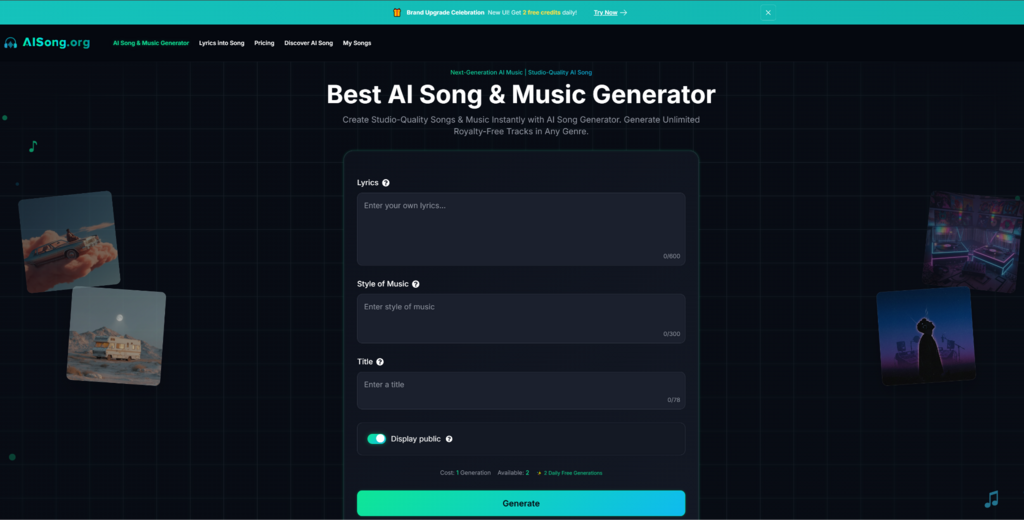
You have a clear concept—“warm, optimistic, mid-tempo”—but the moment you try to turn it into a real track, everything slows down. You open a DAW (or a notes app), then get stuck choosing instruments, tempo, chord color, structure, and how the chorus should lift. That’s the friction an AI Song Generator aims to reduce: not by “magically finishing” your music, but by getting you to a listenable first draft fast enough that you can make informed decisions.
A Different Lens: Treat It Like a “Sketchbook With Speakers”
A helpful metaphor is a sketchbook—except instead of drawings, it produces short audio sketches. Each sketch is not the final painting. It’s a way to answer questions like:
- Does this idea work better as bright pop or warm lo-fi?
- Should the hook be carried by a synth motif or a guitar figure?
- Does the chorus lift feel emotional (harmony) or energetic (drums)?
In my own testing, the “win” was not perfection. The win was speed-to-clarity: I stopped debating adjectives and started reacting to sound.
How the Generator “Understands” You (In Practical Terms)
At a high level, you’re giving the system a brief. It uses that brief to shape a draft by assembling core musical components:
- Melody: a memorable lead line or motif
- Harmony: chord movement and tonal color (warm, tense, uplifting)
- Rhythm: groove, drums, and pacing
- Arrangement: how sections enter, build, and resolve
Before-and-After Bridge: What Changes When You Have a Draft
- Before: “I want it to feel cinematic and hopeful.” (Nice idea, no proof.)
- After: “This version has the right chords, but the drums are too busy under voiceover.” (Actionable feedback.)
That shift—from intent to actionable critique—is where an AI Song Generator can be most useful.
Two Workflows That Feel Meaningfully Different
Description-to-Music: When You Have a Vibe
Use this when you want a theme, a background bed, or a quick prototype. The most reliable results (in my runs) came from prompts that included:
- genre + tempo (or a tight tempo range)
- 2–3 primary instruments
- a simple energy curve (steady, gradual build, chorus lift)
Lyrics-to-Song: When You Have Words
Use this when you already wrote lyrics and want to test singability and cadence. Here, I noticed a pattern:
- If lyric lines had consistent length and rhythm, phrasing felt more natural.
- If lines were irregular, vocals sometimes sounded cramped—often fixable by tightening a few lines rather than changing the whole genre.
A small personal note
The most productive sessions for me were not “generate once and judge.” They were “generate, notice one issue, adjust one variable, regenerate.” That turned it into a craft process instead of a lottery.
A Simple “Studio Notebook” Method (What Made It Predictable)
Step 1: Write a one-screen brief
Include only what actually steers outcomes:
- Tempo: “mid-tempo” or a range (e.g., 100–120)
- Mood: two adjectives (e.g., “nostalgic, optimistic”)
- Palette: 2–3 instruments you want to hear most
- Structure: a basic map (intro → verse → chorus → bridge → chorus)
- Avoid list: what you do not want
Step 2: Generate a small batch intentionally
I typically generated a few drafts in two passes:
- pass one: same prompt to understand variance
- pass two: change one variable at a time (tempo OR palette OR chorus lift)
Step 3: Promote one draft to “direction”
Once one draft felt directionally right, I stopped chasing novelty and focused on refinement (lyrics tightening, structure clarity, or reducing arrangement clutter).
Comparison Table: Where It Fits (Without Overclaiming)
| Decision you need to make | AIely on an AI Song Generator | Do it in a DAW | Hire a producer/composer | Use stock music |
| Get a first draft you can react to | Fast (often minutes; may take iterations) | Slower (setup + skill dependent) | Medium (briefing + turnaround) | Instant but fixed |
| Explore multiple directions today | Strong | Labor-intensive | Limited by schedule | Limited by catalog |
| Fine-grained control (every bar) | Limited | Strong | Strong | None |
| Repeatability (same result each time) | Medium (prompt-sensitive) | High | High | High |
| Best stage to use | Ideation and early drafts | Refinement and finishing | High-stakes finalization | Quick background needs |
| Typical tradeoff | Needs selection + iteration | Time and expertise | Cost and coordination | Generic feel |
Limitations That Make the Experience More Realistic
Not deterministic
Even with the same prompt, outputs can vary. That’s useful for exploration, but it means you should expect selection, not certainty.
Multiple generations are normal
In my testing, it was common to need several attempts to land on the right groove and arrangement balance—especially for hybrid genres.
Vocals can be more variable than instrumentals
When vocals are included, intelligibility and phrasing can fluctuate. Consistent lyric meter and simpler lines often improved outcomes more than “bigger” prompt changes.
Commercial use and licensing require attention
If you plan to monetize or distribute, treat licensing and usage terms as something to read carefully. “Royalty-free” is a phrase people use loosely; real-world permission boundaries live in the specifics.
A Neutral Reference Point (To Keep Expectations Grounded)
If you want broader context on generative AI progress in creative domains—beyond any single platform—neutral reporting like the Stanford AI Index is a useful anchor. It tends to discuss capabilities and adoption trends in a measured way, which can help you keep your expectations practical.
Who This Tends to Help Most
Creators who benefit immediately
- short-form video creators who need quick drafts and variations
- writers who want to hear lyrics performed without a full production setup
- small teams exploring a “brand mood” before commissioning final production
- indie builders prototyping game/app soundscapes
Cases where you may still need traditional production
- projects requiring tight arrangement control and repeatable mixes
- signature releases where transitions and sound design must be intentional
- situations where a human producer’s interpretation is the value
A Practical Closing: What It’s Best At
An AI Song Generator is most convincing when it behaves like a fast draft engine. It doesn’t remove your need for taste; it gives your taste something to judge sooner. In my own use, the biggest benefit was reducing the gap between “I can describe it” and “I can listen to it.” Once that gap shrinks, creative work becomes less about guessing and more about choosing.
One rule that improved my results
Change one variable per iteration. If you change everything, you can’t tell what helped.
