

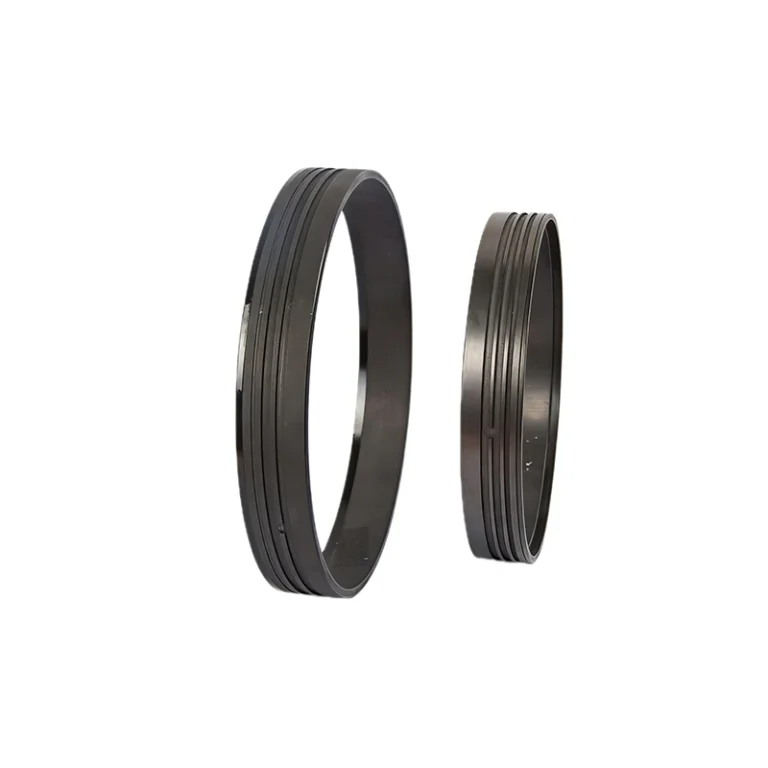
Standard graphite products cover a wide range of applications. But many industrial processes require components that fall outside the range of what off-the-shelf products can provide. A furnace electrode may need a specific diameter and length that is not stocked. A continuous casting die may require a complex internal geometry that cannot be achieved with standard shapes. A semiconductor component may demand graphite with impurity levels measured in parts per million. A heat exchanger may need graphite blocks with integrated channels that must be machined to tolerances tighter than standard products allow.
Custom graphite exists to fill these gaps. It allows engineers and designers to specify the exact shape, dimensions, grade, and treatment required for their application, rather than designing around the limitations of what is available.
The Properties That Make Graphite Customizable
Graphite is uniquely suited to custom manufacturing because it can be produced in a wide range of grades and then machined into almost any shape using standard metalworking techniques. It is soft enough to machine with carbide or diamond tooling, yet strong enough to serve in demanding structural applications. It does not melt or soften at high temperatures. It resists thermal shock. It resists chemical attack. It conducts electricity and heat. It is self-lubricating.
These properties mean that custom graphite components can be designed for applications where no other material works. A custom graphite crucible can hold molten metal without contaminating it. A custom graphite die can shape hot glass without sticking. A custom graphite seal can operate in a chemical pump without corroding. A custom graphite electrode can carry current in an electric arc furnace without melting.
The Grades Available for Custom Work
Custom graphite is not a single material. It is produced in several grades, each with its own properties and intended applications.
Fine-grain graphite is made from finely milled coke and exhibits high strength, excellent surface finish, and low porosity. It is used for electrodes in electrical discharge machining, for semiconductor components, and for applications where precision and cleanliness matter.
Medium-grain graphite is more economical and is used for larger electrodes, furnace components, and general-purpose applications where the finest grain is not required.
Coarse-grain graphite is used where thermal shock resistance is more important than strength. It is common in large electrodes for electric arc furnaces and in applications where rapid temperature changes occur.
High-purity graphite is processed to remove ash and other impurities. It is used in semiconductor manufacturing, nuclear applications, and anywhere contamination must be avoided.
Impregnated graphite is treated with resins or metals to seal porosity, improve strength, or enhance thermal conductivity. Resin-impregnated graphite is impermeable and is used in chemical process equipment. Metal-impregnated graphite is stronger and more conductive and is used in bearings and seals.
The Custom Manufacturing Process
Custom graphite production begins with a conversation between the customer and the manufacturer. The customer provides drawings, specifications, and details about the application. The manufacturer recommends a graphite grade and a manufacturing approach.
The first step is the selection of the raw material. Graphite blanks are produced by mixing petroleum coke with pitch, extruding or molding the mixture into the desired shape, baking it at high temperature, and then graphitizing it at temperatures exceeding 2,500 degrees Celsius. The result is a dense, uniform block of graphite with consistent properties.
The second step is machining. Graphite is machined using carbide or diamond tooling on CNC equipment. The soft, abrasive nature of graphite requires careful tool selection and feeds and speeds. Dust collection is essential because graphite dust is conductive and can damage equipment.
The third step is any required treatment. Impregnation, coating, or purification may be needed to meet the application requirements. Each treatment adds cost but also adds capability.
The fourth step is inspection. Dimensional inspection verifies that the component meets the drawing requirements. Material testing verifies that the graphite meets the specified properties. Documentation is provided to the customer.
What to Consider When Ordering Custom Graphite
The first consideration is the application. What is the component supposed to do? What temperature will it see? What chemicals will it contact? What mechanical loads will it bear? What electrical or thermal conductivity is required? The answers to these questions determine the grade, the design, and the treatment.
The second consideration is the drawing. Custom graphite components must be fully specified. Dimensions, tolerances, surface finish, and any special features must be clearly defined. A good drawing prevents misunderstandings and ensures that the finished part fits and functions as intended.
The third consideration is the quantity. Custom graphite can be produced in small quantities for prototypes or in large quantities for production. The economics change with volume, and the manufacturer can advise on the most cost-effective approach.
The fourth consideration is the supplier. Custom graphite requires a manufacturer with the right equipment, the right experience, and the right quality systems. The supplier should be able to provide material certifications, dimensional inspection reports, and references from similar applications.
The Bottom Line
Custom graphite is not a commodity. It is a specialized product for specialized applications. It allows engineers and designers to specify the exact material, shape, and properties required for their application, rather than compromising on standard products. For industries that operate at high temperatures, handle corrosive chemicals, or require precise electrical and thermal performance, custom graphite components are often the only solution that works.
