

Medical device companies work in a field where quality matters at every step. A device may be used by doctors, labs, hospitals, clinics, or patients. If the product is not made properly, it can affect safety, treatment, and trust.
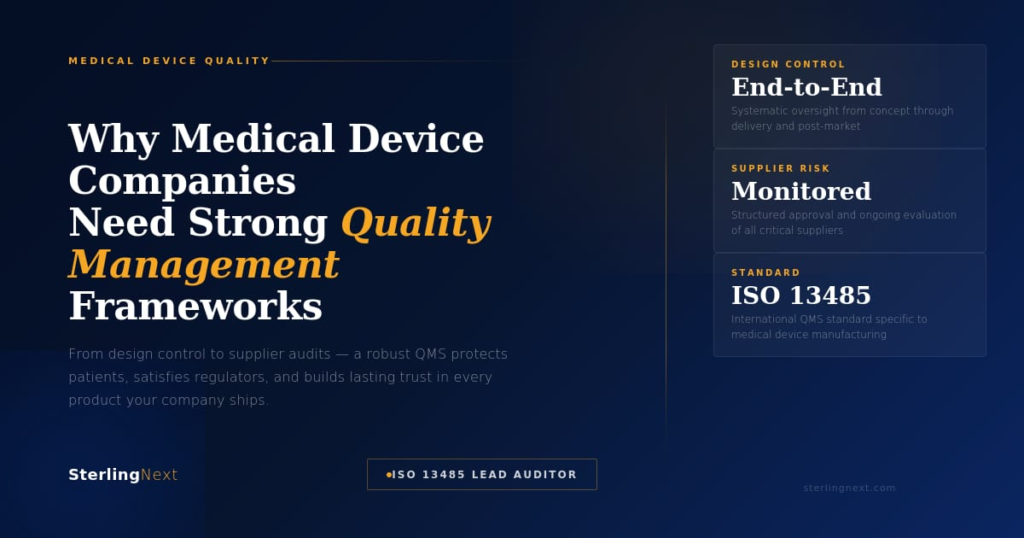
This is why medical device companies need a strong quality management framework. It helps the company control how products are designed, manufactured, checked, stored, and improved. Professionals who want to understand how these systems are reviewed can start with ISO 13485 Lead Auditor Training to learn how medical device quality audits and requirements work.
Quality Needs a Clear System
Quality cannot depend only on individual effort. Even if people are careful, mistakes can happen when there is no clear system.
A quality management framework gives teams proper steps to follow. It explains how work should be done, who is responsible, what records should be kept, and how issues should be reported.
Medical Device Work Needs Strong Control
Medical devices are not ordinary products. They may be used for diagnosis, monitoring, treatment, or patient support. Because of this, companies need strong control over each stage.
This includes product design, material selection, supplier review, production, testing, packaging, storage, and delivery. A framework helps make sure these areas are not managed casually.
Documentation Supports Trust
Documentation is very important in medical device companies. It shows what was done, when it was done, who approved it, and whether the required checks were completed.
When a product issue occurs later, having records allows the company to identify the source of the problem. In the absence of appropriate documentation, it becomes challenging to comprehend what happened or to demonstrate that the correct procedures were adhered to.
Supplier Quality Affects Final Products
Many medical device companies depend on suppliers for materials, parts, packaging, testing, or services. If the supplier’s quality is weak, the final product can also be affected.
A strong quality framework helps companies approve and monitor suppliers properly. It also helps check whether suppliers are meeting quality expectations over time.
Risk Management Becomes Part of Daily Work
Every medical device can carry some level of risk. Companies need to think about what can go wrong and how it may affect users.
A good quality management framework makes risk management part of daily decisions. It helps teams identify risks early and put controls in place before problems become serious.
Audits Help Check the System
A quality framework should not only exist on paper. It should work in daily operations. Audits help check whether teams are actually following the system.
An audit may find missing records, unclear responsibilities, weak supplier checks, poor training, or process gaps. These findings help the company improve before bigger issues happen.
Corrective Action Reduces Repeat Problems
When a problem is found, the company should not only fix it for the moment. It should find the real cause.
Corrective action helps teams understand why the issue happened. Maybe the instruction was unclear. Maybe the employee was not trained. Maybe the supplier process was weak. Fixing the root cause helps prevent the same issue again.
Employees Understand Their Roles Better
A strong framework helps employees understand their responsibilities. Production teams, quality teams, warehouse staff, engineers, purchase teams, and management all have a role in product quality.
When people know what they need to do and why it matters, they follow the process more carefully. This improves consistency across the company.
Customer Confidence Improves
Customers and healthcare partners expect medical device companies to maintain strong quality systems. They want to know that products are made under controlled conditions.
A strong quality management framework helps build this confidence. It shows that the company has a planned and reliable way to manage quality.
Growth Becomes Easier to Manage
As a medical device company grows, work becomes more complex. More products, more suppliers, more employees, and more markets can make quality harder to manage.
A strong framework helps the company grow without losing control. It gives teams a common way to handle quality even when operations expand.
Why ISO 13485 Lead Auditor Knowledge Helps
ISO 13485 Lead Auditor knowledge helps professionals understand how medical device quality systems are checked and improved. It supports better understanding of audit planning, evidence review, nonconformities, corrective actions, and quality system requirements.
This knowledge is useful for quality managers, compliance teams, auditors, regulatory professionals, production managers, and people working in medical device companies. Those who want to explore related learning options can visit SterlingNext medical quality courses for career-focused training paths.
Conclusion
Medical device companies need strong quality management frameworks because their products can directly affect safety and trust. A proper framework helps control design, production, suppliers, documentation, risks, and corrective actions.
Quality should not depend on guesswork or last-minute checks. It should be part of the full system. When companies manage quality properly, they can build safer products, reduce mistakes, and create stronger confidence with customers and healthcare partners.
